





If you work in product development or quality assurance, you have likely heard the terms HALT and HASS. But many engineers confuse these two reliability tests or assume they are interchangeable. The truth is, HALT and HASS serve completely different purposes in the product lifecycle. Using the wrong one at the wrong stage wastes time and money. This article explains the key differences, when to apply each test, and how proper environmental test chambers help you execute both effectively.
What is HALT?
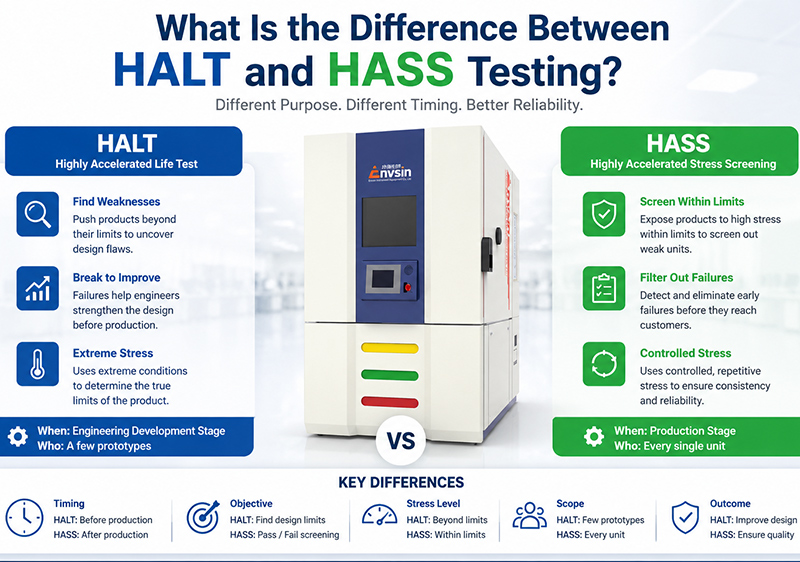
HALT stands for Highly Accelerated Life Test. It is a design discovery process performed during the engineering development phase. The goal is not to pass or fail, but to find the fundamental limits of a product. HALT applies incremental stresses like rapid temperature cycling, multi-axis vibration, and combined environments until failures occur. By identifying weak components or design margins early, engineers can strengthen the product before mass production. HALT typically uses a dedicated chamber capable of extreme ramp rates (up to 70°C per minute) and wide temperature ranges from -100°C to +200°C. A HALT chamber pushes products far beyond their specification limits to reveal hidden defects.
What is HASS?
HASS stands for Highly Accelerated Stress Screening. It is a production screening process applied to 100% of units after manufacturing. Unlike HALT, HASS has a pass/fail criteria. The purpose is to expose process-related defects like poor solder joints, loose connections, or contamination that escaped normal quality control. HASS uses stress levels lower than HALT but higher than the product’s operating limits. A typical HASS profile might include several rapid temperature cycles between -40°C and +85°C combined with random vibration. Any unit that fails is removed from the population. HASS is performed on an environmental test chamber designed for high throughput and repeatability.
Key Differences at a Glance
The main difference lies in timing and objective. HALT happens once per design, usually before production starts. It seeks to answer: How much stress can the design handle before breaking? HASS happens on every production unit. It asks: Does this specific unit contain a manufacturing flaw? HALT uses extreme stresses that go beyond specifications, sometimes destroying products to learn. HASS uses milder, non-destructive stresses that weed out weak units while leaving good ones intact. A HALT chamber requires extreme performance, while a HASS chamber emphasizes speed and consistency.
How They Work Together
HALT and HASS are complementary. First, you run HALT on a few prototypes to discover design margins and set safe stress limits. Those limits become the basis for your HASS profile. During HASS, you apply stresses just below the levels that cause damage but high enough to expose workmanship defects. Without HALT, you would not know how far you can push the product during HASS without causing false failures. Together, they form a complete reliability strategy from design to production.
Common Applications
Industries that demand high reliability—aerospace, automotive, medical devices, telecom—use both HALT and HASS. For example, a new engine control module will undergo HALT to validate the design. Then every production module goes through HASS to catch assembly errors. Consumer electronics manufacturers often skip HALT to save cost, but they risk field failures. Investing in proper HALT and HASS chambers reduces warranty claims and improves brand reputation.
Choosing the Right Chamber for Each Test
HALT requires a specialized chamber with high-performance refrigeration and heating systems to achieve rapid temperature changes. These chambers also integrate vibration tables and often combine stresses simultaneously. HASS can be performed on a standard environmental test chamber that offers fast temperature cycling and good uniformity, but it does not need the extreme ranges of HALT. Some modern chambers are versatile enough to support both roles. Envsin (www.envsin-testchamber.com) provides thermal shock and temperature cycling chambers suitable for HASS screening, as well as custom HALT systems for design validation.
Conclusion
In short, HALT finds design weaknesses before production, while HASS finds manufacturing defects after production. Both are essential for high-reliability electronics. Understanding the difference ensures you apply the right test at the right stage, saving cost and improving product durability. Whether you need a HALT chamber for design validation or a HASS-capable environmental test chamber for production screening, partnering with an experienced supplier makes the difference between catching failures early or discovering them in the field.