





In reliability testing, every second counts — especially when your components face brutal temperature swings. Thermal shock transfer time isn’t just a technical metric; it’s the difference between catching a latent defect and shipping a field failure. For engineers and quality managers who demand precision, understanding this parameter means optimizing test rigor without compromising throughput. At Envsin, we design câmaras de ensaio ambientais that redefine how fast and consistently products endure extreme transitions. So what exactly defines superior transfer time, and why should it dominate your test strategy? Let’s cut through the noise.
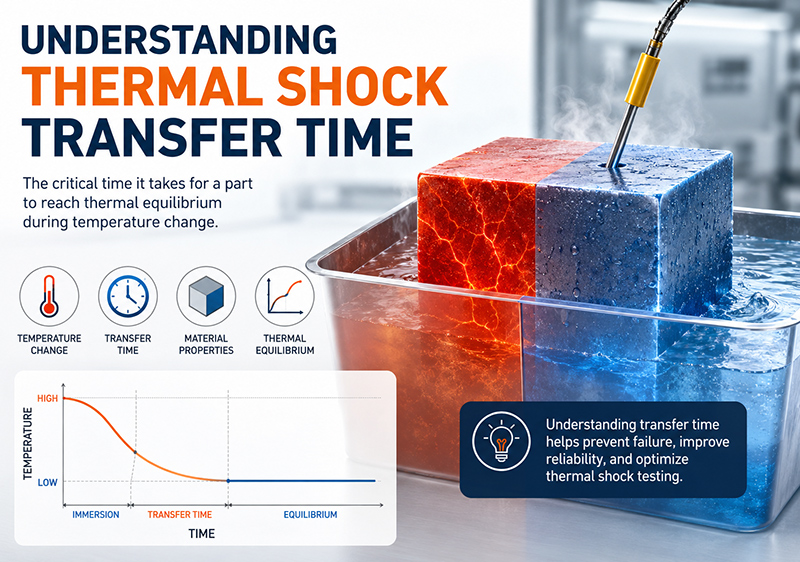
Traditional câmaras de ensaio de choque térmico often struggle with inconsistent basket or carriage movement, leading to unstable thermal shock transfer time and unreliable data. Simply put, transfer time is the interval it takes for a test specimen to move from a hot zone to a cold zone (or vice versa) during a shock cycle. Industry standards like MIL-STD-883 and IEC 60068-2-14 specify transfer times ideally under 10 seconds for most electronic components. Exceed that window, and you risk pre-cooling or pre-heating effects that mask true failure mechanisms. That’s why Envsin engineered our air-to-air câmaras de choque térmico with rapid pneumatic drives and optimized airflow, ensuring transfer time as low as 5 seconds without temperature overshoot.
Short and repeatable thermal shock transfer time directly improves test reproducibility. Consider a semiconductor supplier validating automotive-grade ICs: a delayed transfer could allow gradual temperature drift, invalidating the severity of the shock. With our Envsin test chambers, users gain real-time monitoring of transfer time through intuitive HMI, plus data logging for full traceability. Moreover, energy efficiency rises because rapid transfer minimizes heat loss between zones. We’ve seen labs reduce cycle durations by 18% while meeting stricter JEDEC requirements. This isn’t just about speed — it’s about environmental test integrity and higher product confidence.
What design elements enable such reliable performance? Envsin focuses on three pillars: mechanical robustness, intelligent servo motion, and thermal isolation. Our dual-zone câmaras de ensaio de choque térmico feature separate heating and cooling systems with high-grade insulation, so the specimen never ‘sees’ transitional leakage. The transfer time remains consistent across thousands of cycles. Whether you test printed circuit boards, battery modules, or defense components, predictable transfer time eliminates variability from test method validation. As a leading brand behind www.envsin-testchamber.com, we also provide customizable solutions for extreme ramp rates and large payloads.
To get the most out of your thermal shock transfer time analysis, remember three tips: first, always validate transfer time with an empty chamber and under loaded conditions; second, compare recovery time alongside transfer metrics — Envsin chambers reach stable temperature within 3 minutes after transfer; third, leverage software calibration to align with ISO 17025. When you reduce transfer time uncertainty, you slash the risk of type II errors (false passes). The market is crowded with promises, but actual performance data sets us apart. Contact Envsin today for a test demonstration, and experience how optimized câmaras de ensaio ambientais transform your qualification process from guesswork to science.
In a world where thermal shock test data drives critical design decisions, don’t let excessive thermal shock transfer time dilute your confidence. Fast, repeatable, and precise: that’s the Envsin advantage. Upgrade to chambers that respect both your test standards and your production timelines. Visit www.envsin-testchamber.com to explore models engineered for next-generation reliability.