





You have spent months designing a new onboard camera or an engine control module. The lab results look perfect. Then you send the part to a test house, and it fails within 48 hours of thermal cycling. That is a painful moment for any automotive supplier. The good news is that passing automotive environmental reliability tests is not a matter of luck. It comes down to using the right equipment and understanding what the standards really demand. At Envsin, we help Tier 1 and Tier 2 suppliers avoid those surprises every day.

Automotive components live a hard life. They face desert heat, arctic cold, humidity spikes, and vibration over thousands of hours. That is why carmakers require strict validation through environmental reliability tests. Common standards include ISO 16750, GB/T 2423, and various OEM-specific protocols. If your part fails any of these, your launch date moves back and costs go up.
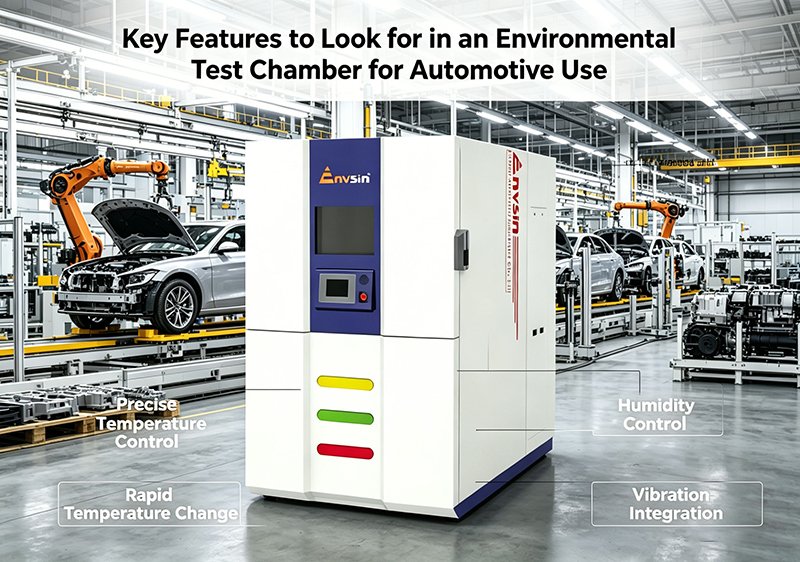
The most critical tests usually involve temperature. A typical environmental test chamber can cycle from -40°C to 125°C repeatedly to check for solder cracks or seal leaks. Some tests add humidity to simulate a rainy day turning into a hot engine bay. Other procedures call for rapid temperature change, such as 15 degrees per minute or faster. For those cases, a thermal shock chamber or a fast-rate test chamber is necessary.
To pass these tests, start with the right chamber. An environmental reliability test chamber must maintain stable conditions without drifting. If your chamber overshoots temperature or fails to recover quickly after opening the door, your results become worthless. Envsin chambers use precision controllers and balanced refrigeration systems to stay accurate throughout long profiles.
Second, plan your test sequence carefully. Many engineers run temperature first and humidity second. Real world conditions often combine them. A better approach is to layer conditions like heat with vibration or humidity with thermal cycling. Combined testing reveals weaknesses that single stage tests miss. For example, a connector might survive dry heat but fail when humidity corrodes the pins after fifty cycles.
Third, document everything. Automotive auditors want to see raw data, not just a pass or fail flag. Your chamber should log temperature, humidity, and time at regular intervals. Envsin systems include built in data logging and export functions to simplify compliance reports. You can also set alarms to catch any deviation before it ruins a batch.
Do not forget calibration. A chamber that reads one degree off can push your test outside the specification limit. We recommend calibration every six to twelve months depending on usage. Use an accredited lab and keep certificates on file for customer audits.
Finally, train your team. Even the best environmental test chamber will produce bad data if operators load samples incorrectly or leave the door open too long. Write a simple work instruction and review it before every major test campaign.
Envsin has supplied chambers to automotive labs across Europe and North America. Whether you test battery packs, sensors, or infotainment systems, we have a solution that fits your floor plan and budget. Visit our website to see models that comply with ISO 16750 and other common standards.