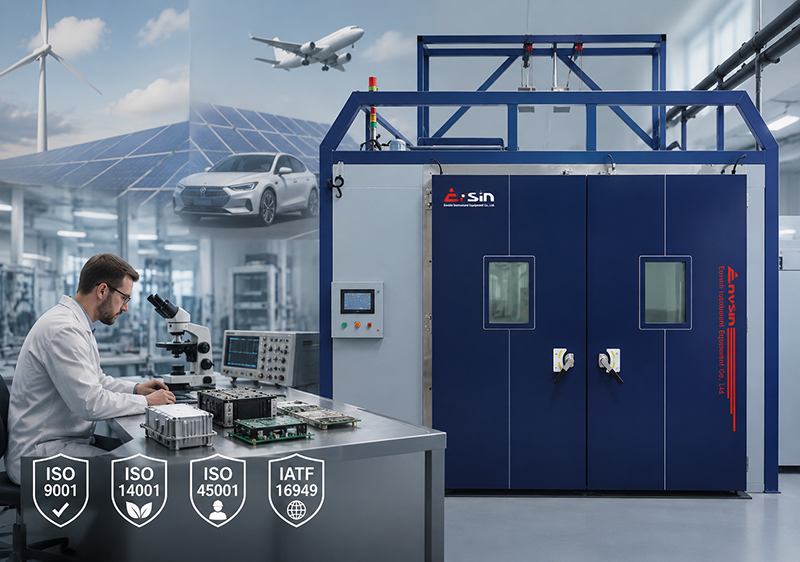







If you manufacture components for automotive, marine, or defense industries, one bad coating can cost millions in recalls. The real dilemma? Choosing between Salt Spray Testing и Humidity Testing — or knowing when to run both. Corrosion doesn’t wait, and neither should your validation process. At Энвсин, we’ve helped engineers across Europe and North America slash field failure rates by designing the right test strategy from day one. Let’s break down the core differences, applications, and why combining both methods gives you the ultimate edge in product reliability.
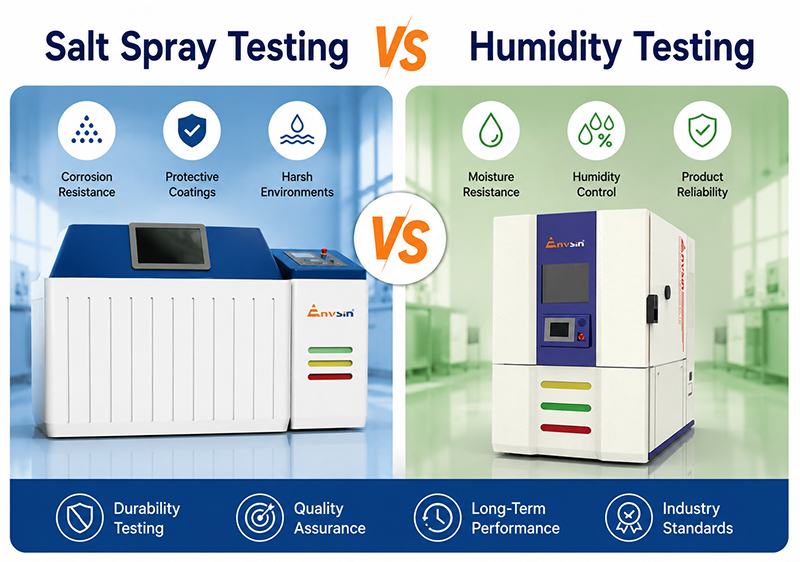
What is Salt Spray Testing?
Salt Spray Testing (often called salt fog test) accelerates corrosion by exposing samples to a highly concentrated saline mist inside a controlled chamber. This method mimics harsh coastal or winter road conditions where salt particles attack exposed metal surfaces. The test follows ASTM B117 or ISO 9227 standards and is brutal: 24 to 1,000 hours inside an камера для экологических испытаний can simulate years of real-world rust. Manufacturers of fasteners, electrical enclosures, and plated parts rely on Salt Spray Testing to qualify coatings, anodized layers, and anti-corrosion treatments. However, the test excels at detecting surface defects but doesn’t replicate cyclical environmental shifts like temperature and moisture condensation.
Understanding Humidity Testing
While salt spray attacks via electrolyte corrosion, Humidity Testing evaluates how moisture absorption, swelling, and galvanic effects degrade materials over time. Operating a камера для испытания на влажность at 85°C / 85% RH (common condition) reveals failures like delamination, insulation breakdown, and oxidation under condensation films. This method is critical for electronics, PCB assemblies, seals, and organic coatings. Unlike aggressive salt fog, Humidity Testing exposes weaknesses in polymer hygroscopy and metal creep corrosion. For products used in tropical or high-moisture environments — from HVAC systems to outdoor LED lighting — this test ensures long-term performance without sudden electrical shorts or material fatigue.
Key Differences: Salt Spray vs Humidity Testing
The primary distinction lies in corrosion mechanisms. Salt Spray Testing accelerates chloride-induced rust, making it ideal for evaluating plating uniformity and pitting resistance. In contrast, Humidity Testing focuses on moisture-driven failure modes such as blistering, hydrolytic degradation, and ionic migration under bias. Another difference: test duration. Salt spray often provides rapid pass/fail indicators within 48–96 hours, while humidity tests may run hundreds of hours to simulate seasonal exposure. But neither is a standalone solution. For example, an automotive connector might survive 500 hours of salt spray but fail humidity cycling due to water ingress. Smart engineers combine both protocols for comprehensive validation.
Why Your Lab Needs Both Methods
Forward-thinking quality managers pair Salt Spray Testing with Humidity Testing to cover real-world damage chains. Think of a coastal radar system: it faces salt-laden fog followed by dew condensation every morning. Using only one test would leave critical gaps. Modern испытательные камеры для окружающей среды с сайта Энвсин allow seamless switching between salt fog, steady humidity, and cyclic corrosion profiles (e.g., Prohesion or VW PV 1200). By integrating both standards in a single chamber platform, you reduce handling variables and replicate authentic field stress. The result: lower warranty claims and stronger market reputation.
When selecting between methods, consider your product’s end use. Offshore components demand heavy Salt Spray Testing cycles, while medical devices inside controlled rooms prioritize Humidity Testing. Yet, leading OEMs now require combined reports. At Энвсин, our salt spray test chambers и humidity chambers are engineered with touch-screen controllers, data logging, and compliance to IEC 60068-2-11, 2-52, 2-67. Don’t guess — validate with precision.
Still unsure which test fits your product lifecycle? Get actionable insights from Энвсин application engineers. Visit www.envsin-testchamber.com to explore our full range of corrosion and climatic chambers — from benchtop units to walk-in rooms optimized for salt fog and humidity profiles. Elevate your reliability testing today.