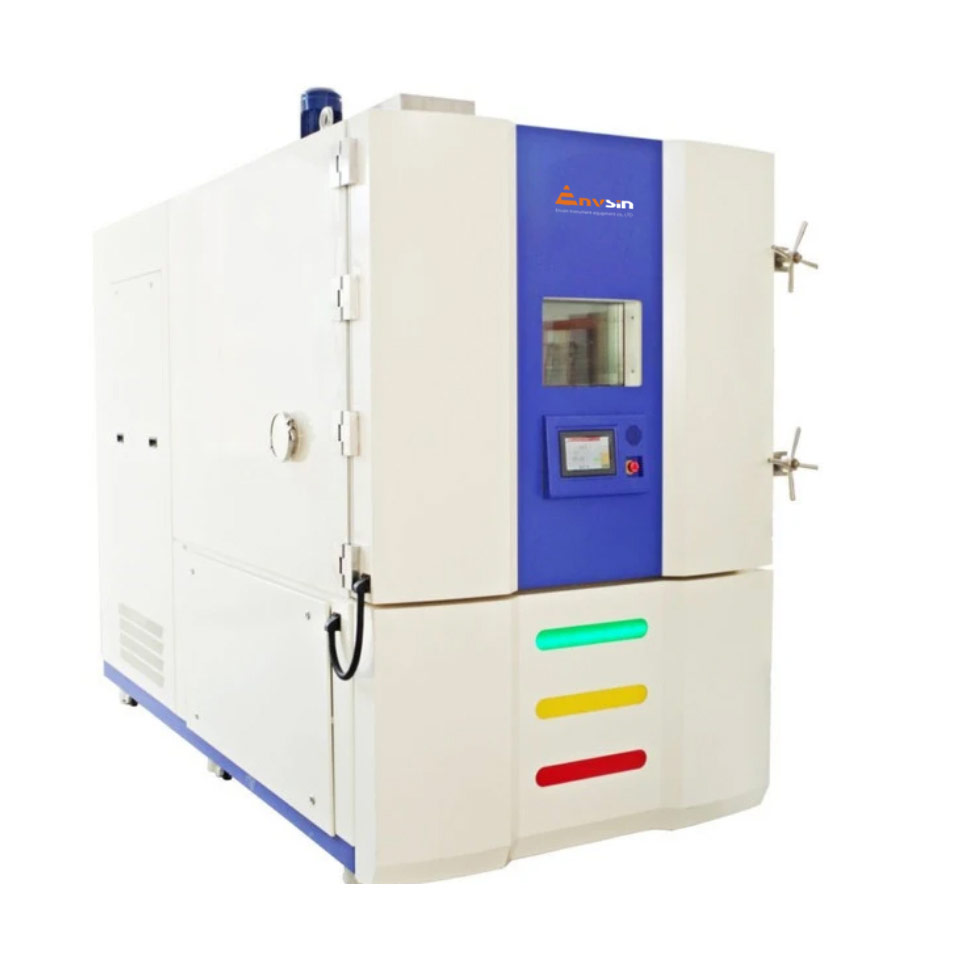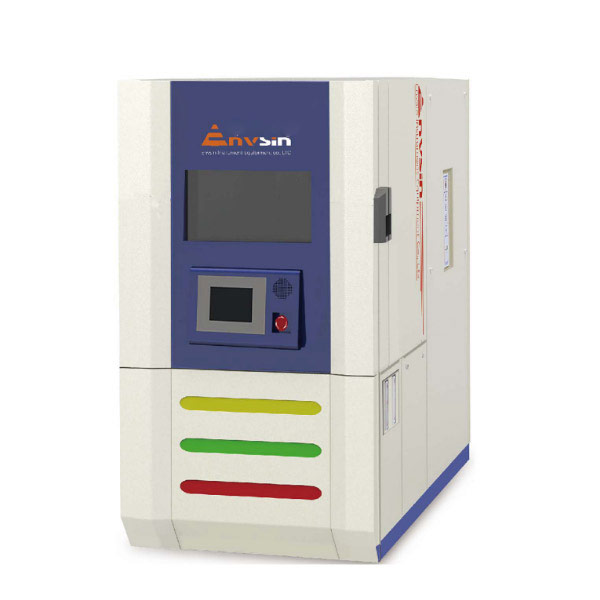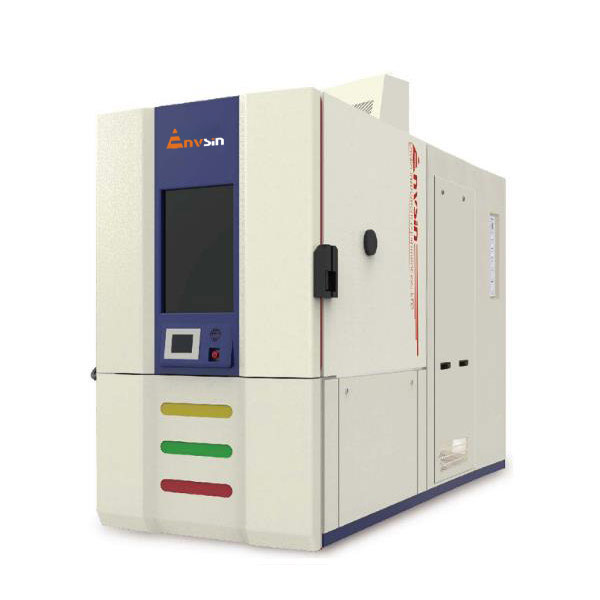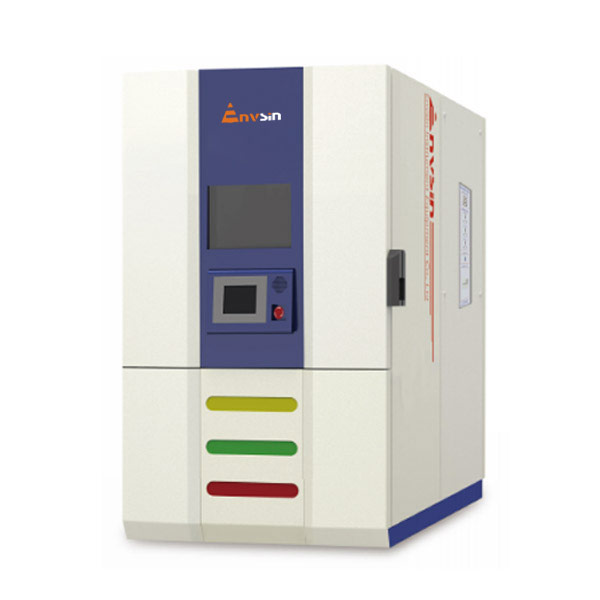
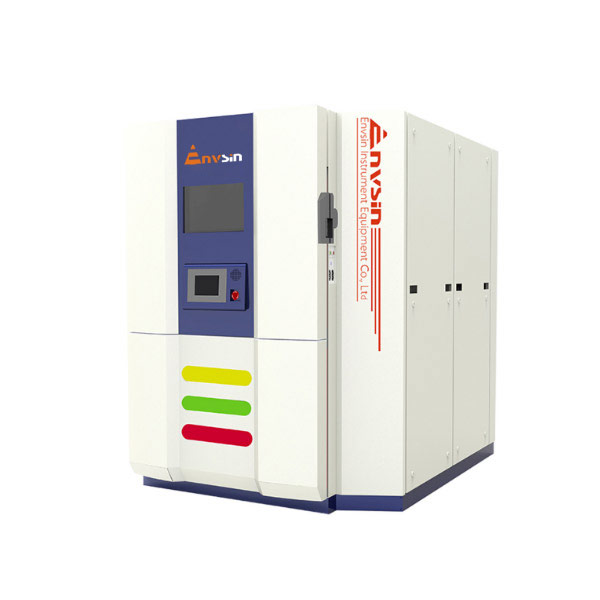
The thermal stress rapid change test chamber system can be divided into two parts: a high-temperature chamber (preheating zone) and a low-temperature chamber (precooling zone). Rapid thermal shock testing is achieved by controlling a movable basket (test sample placement area) to quickly move to either the low-temperature or high-temperature chamber. During the test, the test sample moves along with the movable basket. Compared to high and low temperature (two chambers) thermal shock test chambers, the thermal stress rapid change test chamber has a faster temperature transition speed (stress change time less than 10 seconds), providing more stringent testing for the test samples.
제품 매개변수
| Item | Description / Parameters |
|---|---|
| 테스트 볼륨 | 100 L |
| 작업 챔버 치수 | 500 mm × 500 mm × 400 mm (W×D×H) |
| 전체 치수 | 1170 mm × 2700 mm × 2000 mm (W×D×H) |
| 전원 공급 장치 | AC380V ±10%, 50Hz ±1, 3상 4선식 + 접지선(3/N/PE), 접지 저항 <4Ω |
| 최대 시스템 전력 | Approx.: 49KW (Actual design subject to final engineering design) |
| 최대 시스템 전류 | Approx.: 85A (Actual design subject to final engineering design) |
| 냉각 방법 | Air-cooled type |
| Working Chamber Temperature Shock Test Parameters | Two-chamber test method: Low temperature shock range: -55℃ to -10℃ High temperature shock range: +60℃ to +150℃ 온도 균일성: ≤2℃ 온도 변동: ±0.5℃ 온도 편차: ±2℃ Low temperature rapid change range: -20℃ to -10℃ High temperature rapid change range: 60℃ to 100℃ Stress speed time: <10sec (measured at air outlet) |
| Preheating Zone Temperature Setting | Temperature setting range: +50℃ to +200℃ (Heating time: ambient → +200℃ approx. 40min) |
| Pre-cooling Zone Temperature Setting | Temperature setting range: -80℃ to +70℃ (Cooling time: ambient → -80℃ approx. 80min) |
| 온도 회복 시간 | <5min (measured at air outlet) |
| 온도 전달 시간 | <10sec |
| 적용 가능한 테스트 표준 | Two-chamber test method specifications: 1. GB/T2423.22 2. MIL STD 202F, method 107G 3. IEC 60068-2-14, Test Na 4. BS 2011 5. DIN 40046, Test Na 6. JESD22-A101-A |
제품 특징
1. 현대적인 디자인, 최신 모듈식 제조 기술, 완벽한 제어 기능.
2. Intelligent and independent overload, overheat, power abnormality, overpressure, and actuator fault monitoring and protection design.
3. The test chamber undergoes defrosting once every 700 hours or more.
4. Independent anti-condensation function for the test sample, and over-temperature, no-wind, and smoke protection functions.
5. Breakthrough design with a rapid temperature stress change time of up to 10 seconds.
6. 지능적이고 효율적인 서보 냉각 유량 제어 기술, 에너지 절약, 빠르고 정밀한 온도 상승 및 하강.
5. 이더넷 E-관리 및 USB 데이터 액세스 기능을 갖춘 컬러 스크린 32비트 제어 시스템.
8. 고유한 작동 모드 설계; 테스트 후 챔버는 테스트 샘플을 보호하기 위해 실온으로 돌아갑니다.
9. Expandable APP mobile platform management.
10. Automatic reminders for equipment maintenance and fault record software design for the control system.
11. The testing program features user-friendly intelligent power-off reset, automatic memory continuation, and automatic origin start-up functions.
12. The equipment can be expanded with remote service capabilities and provides a training CD-ROM for machine operation.
애플리케이션 및 시나리오
1. Electronic Components and Circuit Board Testing:
Evaluate the thermal stress response of electronic components and circuit boards under rapid temperature changes, and test their stability and reliability under alternating high and low temperatures.
Test the performance degradation and lifespan of components such as chips, capacitors, resistors, and diodes under rapid thermal stress conditions.
2. 자동차 산업:
Evaluate the thermal stress response of automotive parts and vehicle systems under rapid temperature changes, and test their stability and durability in extreme temperature environments.
Test the performance of engine components, transmission systems, and body structures under rapid thermal stress conditions.
3. 항공우주:
Evaluate the thermal stress response of aerospace components and spacecraft materials under rapid temperature changes, ensuring their stability and reliability in space or high-altitude environments.
Test the performance of aircraft components, spacecraft parts, and external coatings under rapid thermal stress conditions. 4. Materials Science:
Evaluate the thermal stress response of new materials under rapid temperature changes, and study their stability and reliability in practical engineering applications.
Test the performance of composite materials, metallic materials, polymer materials, etc., under rapid thermal stress conditions.
5. 제약 및 생명공학:
Evaluate the stability and activity of pharmaceuticals and biological products under rapid temperature changes, ensuring their quality and efficacy during storage and transportation.
Test the performance of vaccines, biopharmaceuticals, biological samples, etc., under rapid thermal stress conditions.
6. Construction and Building Materials:
Evaluate the thermal stress response of building materials under rapid temperature changes, and test their stability and durability under different climatic conditions.
Test the performance of building materials such as concrete, glass, and metal structures under rapid thermal stress conditions.