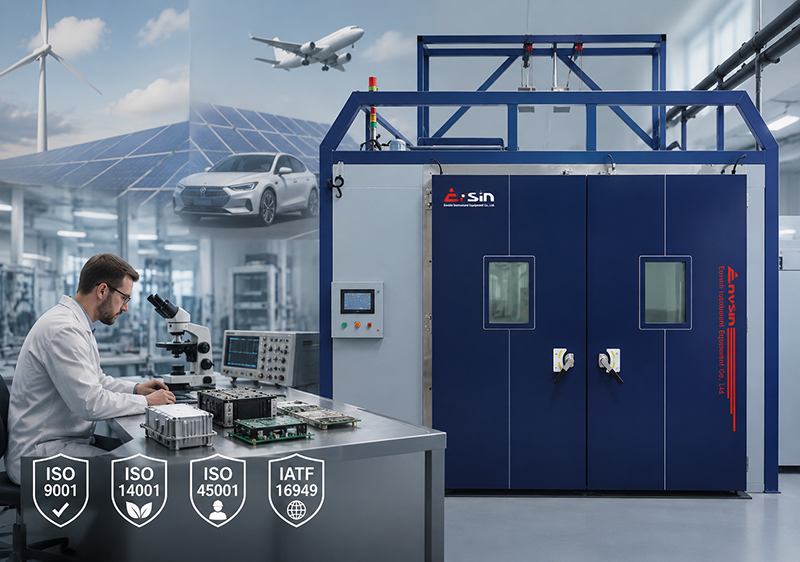






During accelerated lifecycle testing of an 800V EV battery pack, a leading automotive supplier observed sudden voltage drops after only 150 thermal cycles between -40°C and +85°C. Standard charge-discharge protocols had passed the module design, but the rapid expansion and contraction of internal cell layers exposed a latent weld failure. That is precisely where Envsin environmental testing solutions become essential. Envsin 환경 테스트 챔버 are engineered to replicate real-world thermal loads, humidity transients, and mechanical stress sequences that reveal failure modes otherwise hidden until field deployment.
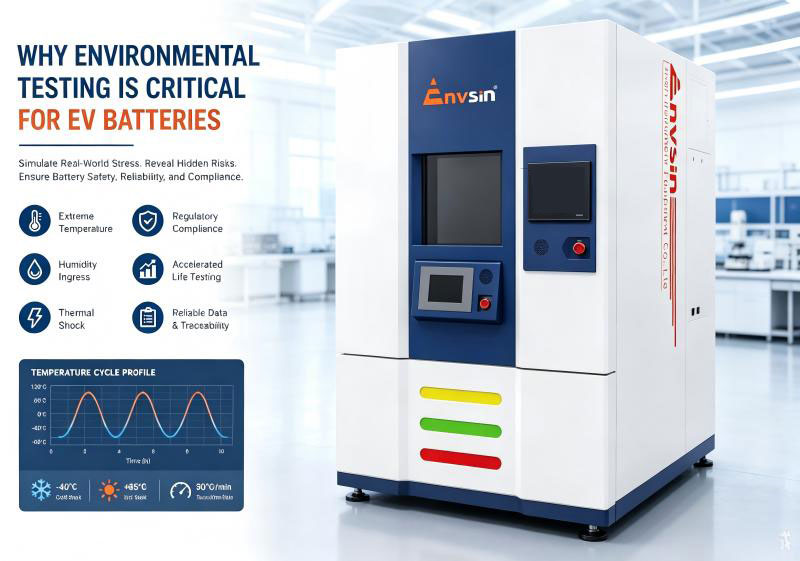
For lithium-ion battery systems used in electric vehicles, the margin between reliable operation and thermal runaway is measured in millivolts and seconds. EV battery testing must go far beyond simple capacity checks. Engineers need to simulate years of seasonal temperature swings, rapid charging in hot climates, and cold-soak starts in Nordic winters—all within compressed development timelines. Without controlled stress screening, materials degrade unpredictably, separators shrink, and internal resistance rises, leading to accelerated aging or catastrophic short circuits.
Battery reliability testing therefore hinges on replicating three core stressors: extreme temperature, humidity ingress, and thermal shock. A cell that performs perfectly at 25°C can lose 30% of its cycle life when repeatedly exposed to 60°C and 95% relative humidity. More critically, the transition between hot and cold phases induces mechanical fatigue in busbars, welds, and cell casings. This is why a 열충격 챔버 is not optional but mandatory for any serious validation plan. Envsin thermal shock chambers achieve transition rates exceeding 30°C per minute, allowing engineers to uncover interfacial delamination, electrolyte decomposition, and current collector corrosion within weeks rather than years.
Consider a pouch cell assembly destined for a European passenger EV. The battery management system may compensate for temperature gradients, but it cannot counteract uneven aging caused by localized hot spots during rapid charge-discharge cycles. A 온도 테스트 챔버 with precise ramp rate control and uniform airflow distribution ensures that each cell experiences the same thermal profile. Without this uniformity, test results become non-repeatable, and production-quality decisions rest on flawed data. Envsin chambers are designed with advanced air circulation and multi-zone sensing to maintain stability even during maximum thermal load conditions, supporting everything from single-cell tests to full 800V pack validation.
Beyond performance validation, regulatory frameworks such as UN R100, GB/T 31467, and ISO 16750 demand documented environmental testing evidence for type approval and market access. In North America, UL 2580 requires thermal cycling and humidity exposure for traction batteries. European certifying bodies expect clear traceability from test setup to final report. Envsin chambers integrate with data acquisition systems to provide audit-ready records of temperature profiles, dwell times, and transition rates, helping manufacturers reduce certification delays.
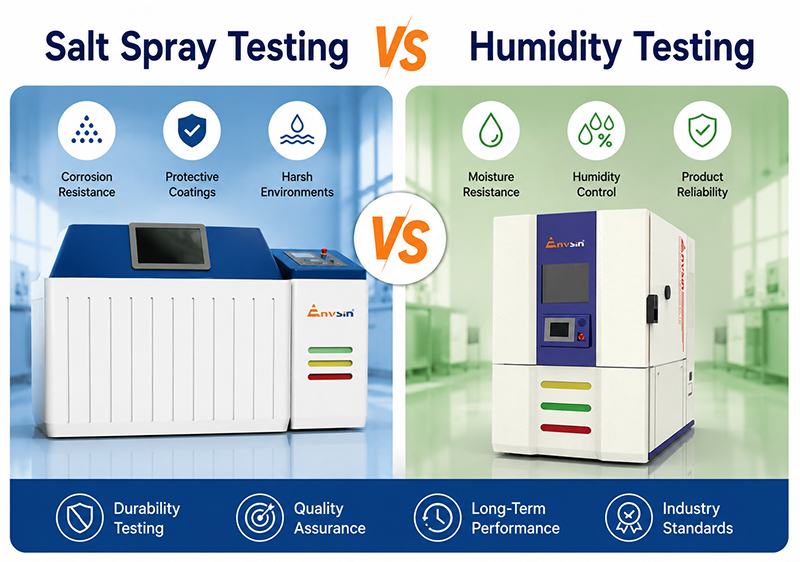
Another often overlooked risk is condensation inside battery enclosures during humidity cycling. Moisture that enters through breather valves or connector seals can trigger low-voltage insulation failures or corrode high-voltage interconnects. EV battery testing protocols must include controlled humidity ramps combined with temperature steps to simulate day-night cycles and washing bay exposure. Envsin walk-in and modular chambers support these combined environment profiles with integrated humidity control from 10% to 98% RH, matching real field conditions for commercial vehicles, off-highway machinery, and passenger cars alike.
For R&D teams working on next-generation solid-state and high-nickel cathodes, the stakes are even higher. These chemistries exhibit different expansion coefficients and thermal sensitivities. Standard automotive profiles often need customization. That is where Envsin provides direct engineering consultation to define test sequences that match specific cell formats, cooling strategies, and target operating regions—from hot desert environments to subarctic conditions.
If your EV battery validation program requires robust battery reliability testing under realistic thermal and humidity stresses, discuss your specific requirements with the Envsin engineering team. We design and manufacture temperature, humidity, thermal shock, and walk-in chambers tailored to your cell chemistry, pack architecture, and compliance standards. From early R&D characterization to production quality assurance, Envsin delivers customized environmental testing solutions that support your entire EV battery development lifecycle.
Contact us to review your test conditions and chamber specifications.