





When products grow too large for benchtop or reach-in environmental chambers, the natural next step is a walk-in test chamber — a room-sized system designed to accommodate full assemblies, vehicles, battery packs, or multiple test specimens simultaneously. But selecting one isn’t simply a matter of picking the biggest chamber that fits the budget. It’s a systems engineering decision that involves airflow dynamics, heat load management, safety architecture, and long-term operational efficiency.
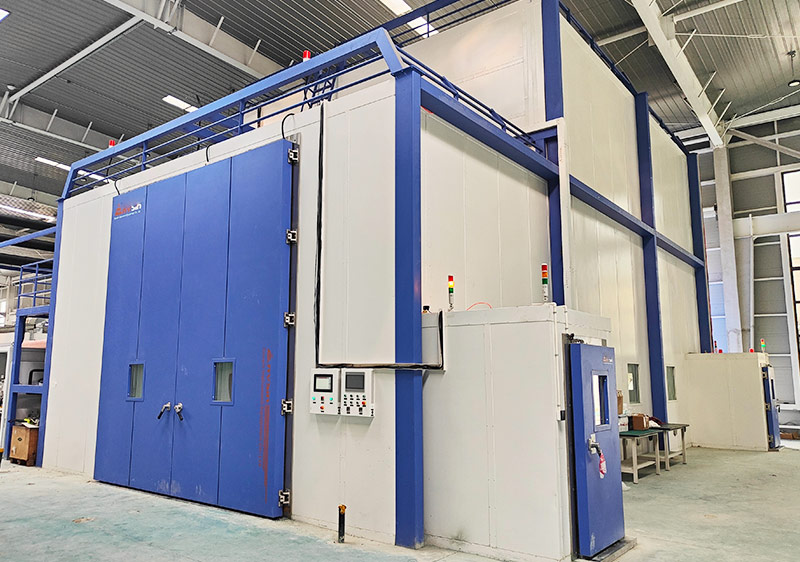
A poorly specified chamber can mean failed certifications, inconsistent test data, and costly redesigns. This article provides a systematic framework for selecting the right walk-in test chamber for large products, covering everything from core parameters to installation planning.
1. Start with Your Application: Standards and Testing Objectives
Before diving into technical specifications, clarify what you’re testing and which standards apply. Different industries demand different conditions:
- Electronics: Temperature/humidity cycling per IEC 60068 standards
- Automotive: Full-system validation, often requiring ISO 16750 compliance and large-scale environmental stress screening
- Aerospace & Defense: Harsh environment simulation per MIL-STD-810, with potential integration of altitude or vibration systems
- Battery & Energy Storage: Explosion-proof features, gas detection, and safety venting per evolving safety standards
Defining these requirements early ensures the chamber’s technical specifications are aligned with compliance needs, not just catalog specs.
2. Dimensioning the Chamber: Size, Volume, and Airflow
For large products, chamber sizing goes beyond simply fitting the object inside. Two critical principles apply:
The 1:3 Rule: To ensure uniform airflow and accurate test conditions, the test load should ideally occupy no more than one-third of the internal chamber volume. Crowding the chamber disrupts air circulation, causing temperature and humidity gradients that compromise test validity.
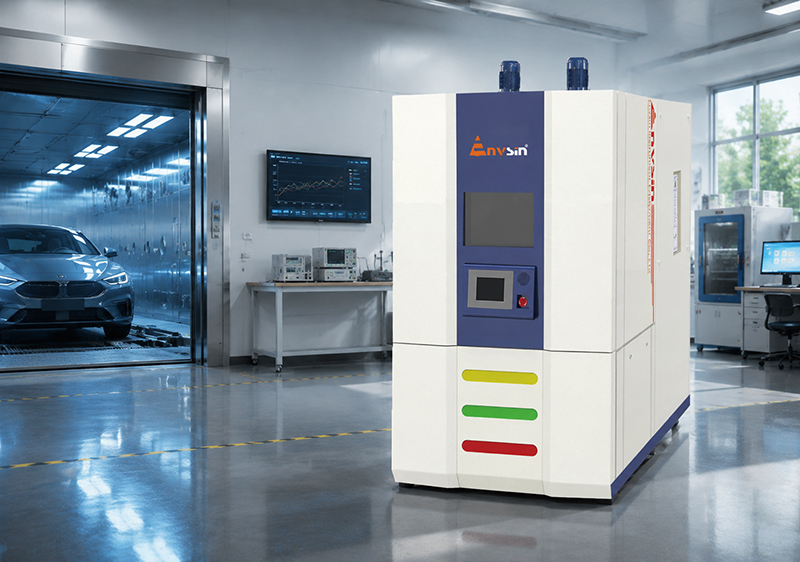
Operational Clearance: Beyond the product footprint, factor in space for personnel access, shelving, trolleys, and future test configurations. Walk-in chambers are available in volumes from approximately 4 m³ up to 260 m³ and beyond, with standard sizes commonly ranging from 8 m³ to 40 m³. Custom sizes — including drive-in chambers capable of accommodating entire vehicles — are achievable through specialized manufacturers.
A common pitfall is pursuing “bigger is better” without assessing the actual product portfolio. Oversized chambers increase energy consumption, installation complexity, and operating costs without delivering proportional testing benefits. Measure your largest product precisely and add reasonable margins for airflow and future needs — but resist the temptation to over-specify.
3. Temperature and Humidity: Matching the Range to Your Worst-Case Scenario
Walk-in chambers can achieve temperature ranges from approximately -70°C to +150°C (with some configurations reaching +180°C) and humidity ranges from approximately 10% to 98% RH. However, extreme values come with trade-offs:
- Wider temperature rangesrequire more powerful and complex refrigeration and heating systems. Achieving -70°C typically demands cascade refrigeration configurations, which add significantly to system complexity and operating costs.
- Cambios rápidos de temperatura(e.g., 5°C/min or higher) place substantial demands on compressor horsepower and structural design, directly impacting equipment cost and energy consumption.
Temperature and humidity uniformitymatter as much as the extremes. For reliable testing, look for temperature uniformity of ±2°C or better and humidity uniformity of ±5% RH or better. Premium systems can achieve ±1°C and ±3% RH respectively, which becomes critical for long-term stability testing and high-precision applications.
Key advice: Define your necessary range based on actual product requirements and applicable standards — not on the theoretical maximum a manufacturer can offer. Blindly pursuing wider ranges inflates costs without necessarily improving test outcomes.
4. Construction Type: Modular vs. Solid-Welded
The chamber’s structural design directly affects performance, installation, and long-term durability:
| Construction Type | Temperature Limit | Best For |
| Modular / Panelized | Up to +85°C | Steady-state stability testing, pharma storage, mild electronics testing |
| Solid-Welded (Stainless Steel) | Up to +180°C | Rapid thermal cycling, extreme humidity, high-temperature applications |
| Drive-In (Specialized) | Application-dependent | Full-vehicle testing, aerospace components, battery safety validation |
Modular chambers use cam-lock polyurethane panels and are easier to install in existing facilities, but they can suffer from panel delamination under aggressive thermal cycling. Solid-welded interiors using 304 or 316L stainless steel provide a superior hermetic seal and are mandatory for high-moisture testing or temperatures above 85°C — though they come with a higher manufacturing cost.
5. Safety and Compliance: Non-Negotiable Requirements
Safety features are often the most overlooked aspect of chamber selection — and the most consequential when things go wrong.
For general applications, essential safety protections include: over-temperature and over-pressure protection, emergency shut-off with audible alarms, humidifier dry-combustion protection, refrigerant high-pressure protection, water shortage protection, and earth leakage protection.
For high-risk applications (EV batteries, aerospace components, flammable materials), walk-in chambers must integrate: gas exhaust systems, pressure relief panels, fire detection and suppression interfaces, and explosion-proof blowers. These hazard-level safety packages are critical for testing safety and must be configured specifically according to the actual risk level.
Standards complianceshould also be verified early. Depending on your industry, the chamber may need to conform to IEC 60068, ISO 16750, MIL-STD-810, ASTM D2247, SAE J1211, or pharmaceutical standards such as ICH Q1A. Confirm with the supplier that the chamber can support relevant certifications and provide validation documentation (IQ/OQ/PQ) if your industry requires it.
6. Control Systems and Data Integration
Modern walk-in chambers should support Industry 4.0 connectivity. Look for:
- Programmable controllerswith touchscreen interfaces supporting multiple test profiles (ramp, soak, cycle)
- Remote monitoringvia Ethernet, RS232/RS485, USB, or cloud-based platforms
- Real-time data loggingwith audit-ready traceability for compliance requirements
- LIMS and automation integrationcapabilities for seamless workflow digitization
Chambers that lack open protocols and interoperability can become bottlenecks as laboratories modernize their data management infrastructure.
7. Installation Planning: What Your Facility Needs
A walk-in chamber is not a plug-and-play device. Installation requires careful preparation:
Floor loading: The installation site should support at least 800 kg/m² (or ≥500 kg/m² for lighter configurations), with structural reinforcement for high-power customized units.
Clearance: Leave at least 80 cm around all sides of the chamber for maintenance access, and 150 cm in front. Ceiling height should accommodate the chamber (typically 2.5–3 meters) plus at least 0.5 meters above for service.
Potencia: Most walk-in chambers require 3-phase 380V/50Hz power with a dedicated circuit breaker panel and proper grounding (earth resistance ≤4Ω). Total power can range from 15 kW to 100 kW depending on chamber size and performance requirements.
Environment: The room housing the chamber should maintain 10–30°C ambient temperature year-round, away from direct sunlight, dust, and vibration sources. Water-cooled systems additionally require adequate cooling water quality and pressure.
Be sure to allocate dedicated budget and time in advance for facility preparation and on-site commissioning.
8. Common Pitfalls to Avoid
Based on real-world procurement experiences, here are five traps that derail walk-in chamber projects:
- Ignoring lab compatibility: A chamber that doesn’t fit through doorways, exceed floor load limits, or integrate with existing power infrastructure becomes an instant liability — not an asset.
- Pursuing a “universal system”: All-in-one chambers that promise every possible environmental condition tend to be complex, expensive to maintain, and underutilized. Match capabilities to actual testing needs.
- No future-proofing: Chambers are long-term assets (10+ years). Systems without modularity or upgrade paths may become obsolete as testing standards evolve, forcing costly reinvestment.
- Underestimating after-sales support: Supplier response time, spare parts availability, and technical support quality directly affect uptime. A chamber that sits idle waiting for service disrupts entire R&D timelines.
- Ignoring control system limitations: Inadequate data logging and poor integration with laboratory systems can compromise test repeatability, traceability, and compliance.
9. Selection Checklist
Use this summary checklist to guide your procurement process:
- ☐ Define testing application, applicable standards, and required certifications
- ☐ Measure largest product dimensions and calculate required internal volume (1:3 airflow ratio)
- ☐ Determine required temperature/humidity range and ramp rates (based on standards, not maximum specs)
- ☐ Select construction type (modular vs. welded) based on thermal cycling demands
- ☐ Specify safety features matching the risk level of test samples
- ☐ Verify control system compatibility with LIMS and data management infrastructure
- ☐ Assess installation site: floor load, power, clearance, ambient conditions
- ☐ Evaluate supplier service network, response times, and spare parts availability
- ☐ Plan for future expansion needs and modular upgrade options
Conclusion
Choosing the right walk-in test chamber for large products is a strategic decision — not a catalog selection. It requires balancing core performance parameters (size, temperature/humidity range, ramp rates) with structural design, safety architecture, installation logistics, and long-term operational efficiency. By following a systematic evaluation process and avoiding common pitfalls, you can select equipment that delivers accurate, repeatable results for years to come.
Need help with your specific application? Reach out to a qualified environmental chamber manufacturer or testing consultant to discuss your requirements in detail.