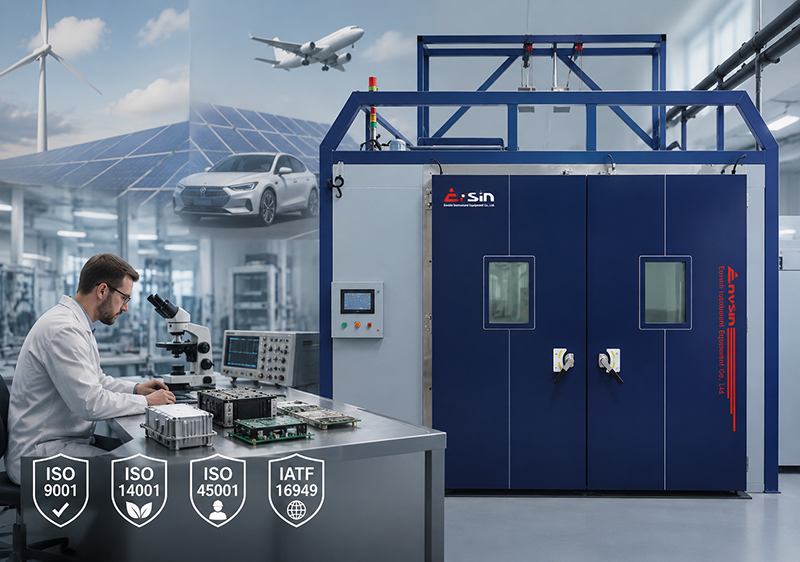






Thermal runaway remains the number one enemy of high-capacity battery packs used in electric trucks and grid storage. When a single cell overheats, the entire assembly can cascade into catastrophic failure within seconds. Yet standard benchtop chambers simply cannot fit a complete 800V battery system along with its coolant loops and monitoring hardware. This is exactly why cámaras walk-in have become non-negotiable for serious manufacturers. These large-scale environmental test chambers allow engineers to evaluate thermal behavior, humidity resilience, and mechanical integrity under real-world extremes — without disassembling the pack. If you skip full-size validation, you risk missing cell-to-pack interaction flaws that only appear inside a walk-in chamber.

Testing large battery packs is not just about dimensions; it’s about duplicating actual field stresses. Automotive and energy storage OEMs need to simulate desert heat, arctic cold, and sudden humidity shifts while monitoring individual cell voltages. Conventional chambers lack the interior volume to house a full battery system plus auxiliary test equipment. Here, cámaras walk-in solve the scale problem. For instance, Envsin’s walk-in solutions provide spacious interiors that accommodate entire racks of large battery packs with room for thermal imaging cameras and data loggers. Maintaining uniform temperature distribution across a 2-meter-long battery is a challenge that only high-performance cámaras de pruebas ambientales can handle. Without walk-in capability, hot spots or condensation risks stay hidden until the product reaches the road or renewable site.
Beyond size, safety protocols demand dedicated space. When simulating nail penetration or overcharge conditions on large battery packs, engineers need proper clearance for venting and emergency shutdown systems. Walk-in chambers integrate explosion relief ports, gas monitoring sensors, and reinforced doors – features impossible to implement in small units. Moreover, regulatory standards like UN38.3 and IEC 62660 explicitly require full-pack testing under controlled temperature and humidity cycles. Cámaras de acceso make these test sequences repeatable, automated, and documented. Leading chamber providers like Envsin also offer modular panel designs, so as your battery dimensions grow, the chamber adapts without expensive rebuilds. By combining wide temperature ranges (-70°C to +180°C) with precise humidity control, these chambers reveal mechanical swelling, seal degradation, and terminal corrosion long before they cause field failures.
For EV producers, energy storage integrators, and aerospace battery developers, the return on investment is clear. A single recall caused by undetected thermal propagation can cost millions and damage brand reputation. Cámaras de acceso provide the only cost-effective way to certify large battery packs under accelerated life tests. At Envsin, we engineer custom cámaras de pruebas ambientales that meet the most stringent battery test specifications – from steady-state aging to rapid thermal shock. Our walk-in series features homogeneous airflow, touchscreen PLC control, and remote monitoring via Ethernet. Whether you qualify prismatic, pouch, or cylindrical cells inside a pack, a walk-in chamber eliminates scaling errors. Ready to validate your battery system with professional-grade reliability? Visit www.envsin-testchamber.com to explore how Envsin’s walk-in chambers turn large battery testing into a precise, safe, and repeatable process.