






Humidity testing is essential for evaluating product reliability in moist environments. However, one frequent challenge that engineers and lab managers encounter is condensation–water droplets forming inside the test chamber or on the product surface. Understanding what causes condensation during humidity testing is critical for accurate, repeatable results and for preventing product damage. In this guide, Envsin, a professional environmental test chamber manufacturer, explains the core mechanisms behind condensation and how to control it effectively.
The Basic Physics of Condensation
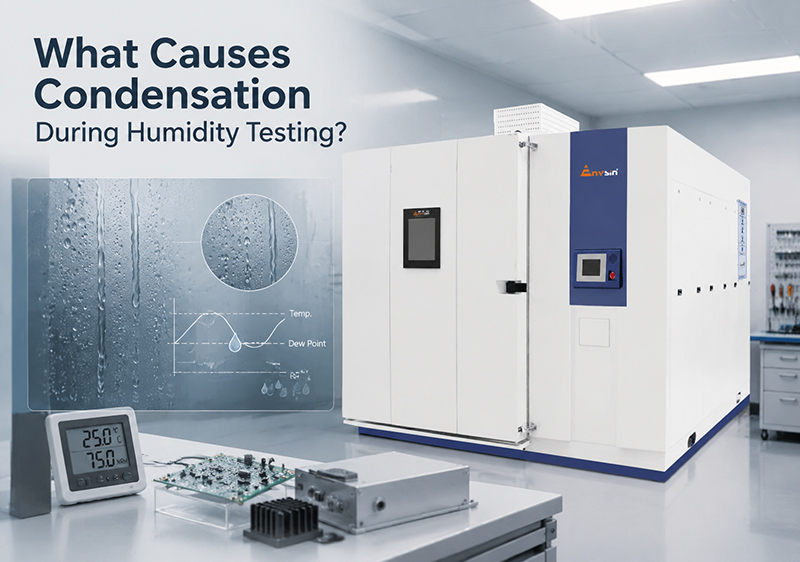
Condensation occurs when warm, moisture-laden air comes into contact with a surface whose temperature is at or below the dew point. In the context of a humidity test chamber, this means that if the product being tested–or internal chamber walls–is colder than the dew point of the surrounding air, water vapor will transition into liquid water.
Key factors include:
- Temperature differences between the product and the chamber air
- Rate of humidity rise during testing
- Surface materials and thermal mass of the test specimen
Why Condensation Happens Specifically in Humidity Chambers
When using a temperature humidity chamber, the control system heats and humidifies the internal environment. If the chamber temperature is raised quickly while humidity increases, the product surface may lag behind in temperature. This lag creates a classic condensation scenario. Common causes include:
1.Rapid humidity ramping–Adding moisture faster than the product can warm up
2.Cold start conditions–Starting a test with a cold product inside a warm, humid chamber
3.Poor chamber air circulation–Uneven temperature distribution leads to local cold spots
4.Insufficient pre-conditioning–Not stabilizing product temperature before starting humidity control
The Risks of Uncontrolled Condensation
While a small amount of condensation inside the test chamber may seem harmless, it can:
- Cause electrical shorts on PCBs or sensors
- Promote corrosion on metal components
- Affect optical or precision mechanical properties
- Lead to false failures or invalid test results
For industries such as automotive electronics, aerospace, and medical devices, managing condensation is not optional – it is a compliance necessity.
How a Quality Environmental Test Chamber Prevents Condensation
A well-designed programmable temperature humidity chamber minimizes condensation through:
- Cascaded PID control–Balancing temperature and humidity ramp rates
- Dry air purge systems–Removing moisture before opening the chamber
- Anti-condensation wall heaters–Keeping inner surfaces above dew point
- Controlled soak times–Allowing product temperature to equalize
At Envsin, every environmental test chamber we engineer includes intelligent condensation management features, ensuring that your humidity testing remains accurate and artifact-free.
Best Practices to Reduce Condensation
To avoid condensation during your own humidity tests, follow these steps:
- Preheat the chamber with the product inside before injecting humidity
- Limit the dew point rise speed to ≤1 °C per minute
- Use a stepped humidity profile rather than a single sharp ramp
- Always run an empty chamber validation before critical tests
Conclusion
Condensation during humidity testing is primarily caused by temperature differentials between the test specimen and the moist air inside the humidity test chamber. By understanding these causes and selecting a high-quality environmental test chamber such as those from Envsin, you can dramatically improve test repeatability and protect your valuable products from moisture-related damage.For more technical insights or to discuss your specific testing requirements, visit https://www.envsin-testchamber.com or contact our engineering team directly.