







Imagine investing weeks in product validation, only to realize you picked the wrong temperature test method. Thermal shock and temperature cycling are both critical for reliability, yet they expose materials and electronics to completely different stresses. Choosing incorrectly can hide early failures — or waste budget on over-testing. In this guide, we break down the key differences between thermal shock vs temperature cycling, when to use each, and how Envsin’s advanced environmental test chambers deliver precise, repeatable results for both methods. Let’s cut through the confusion.
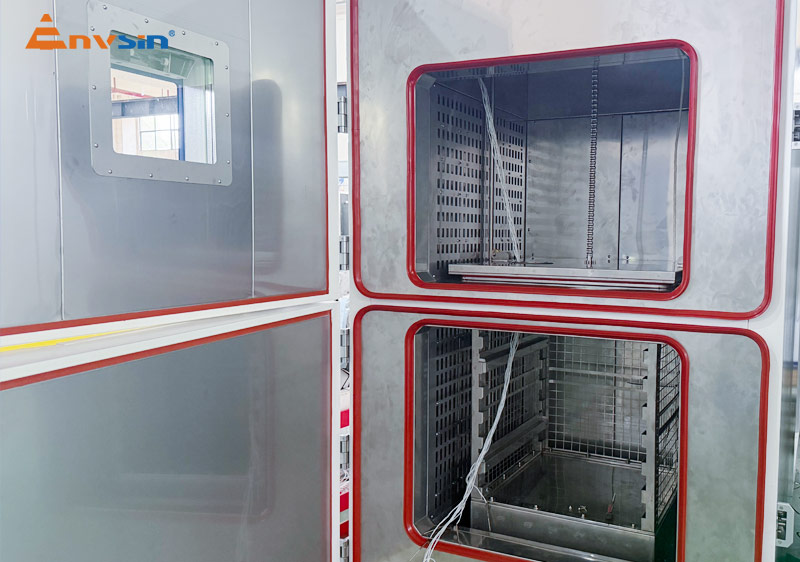
What is Thermal Shock Testing?
Thermal shock testing exposes a product to extremely rapid temperature changes, often transitioning between hot and cold chambers in seconds (typically <10–20 seconds). This abrupt change creates intense internal stresses, revealing structural weaknesses, coating delamination, seal cracks, and solder joint failures. Standards like IEC 60068-2-14 (Test N) and MIL-STD-883 define thermal shock as a drastic rate of change exceeding 30°C/min, sometimes instantaneous. Envsin’s thermal shock chambers (two-zone or three-zone) deliver consistent shock cycles for aerospace, automotive, and electronics industries.
What is Temperature Cycling?
Temperature cycling uses controlled ramp rates (typically 5–15°C/min) between temperature extremes, staying at each extreme for a set dwell time. It simulates real-world diurnal or seasonal temperature changes, focusing on material fatigue, expansion/contraction mismatch, and long-term mechanical wear. This method is essential for consumer electronics, EV batteries, and industrial controls. Temperature cycling chambers from Envsin feature high ramp efficiency and uniform airflow, helping engineers validate product lifetime under gradual thermal stress — not sudden shocks.
Core Differences at a Glance
Thermal Shock
- Transition speed: < 10–20 sec (air-to-air or liquid-to-liquid)
- Rate of change: > 30°C/min, often instantaneous
- Primary failure mode: Cracks, delamination, hermetic seal failure
- Typical standards: MIL-STD-883, JESD22-A106, IEC 60068-2-14 Nb
- Best for: Military, avionics, sudden environment change scenarios
Temperature Cycling
- Transition speed: 3–15°C/min (controlled ramp)
- Rate of change: Moderate, programmable profile
- Primary failure mode: Solder joint fatigue, connector wear, seal aging
- Typical standards: IEC 60068-2-14 Na, JESD22-A104, ISO 16750
- Best for: Automotive, consumer electronics, renewable energy
📊 Detailed Comparison Table
| Parameter | Thermal Shock Testing | Temperature Cycling |
|---|---|---|
| Temperature change rate | Extreme (>30°C/min, often <10 sec transfer) | Gradual (3–15°C/min typical) |
| Test duration | Shorter cycles (e.g., 100–1000 shocks) | Longer cycles (weeks to simulate years) |
| Stress mechanism | Thermal shock induced stress (mechanical shock) | Cyclic fatigue due to expansion/contraction |
| Chamber architecture | Two-zone or three-zone (hot/cold separate) | Single-zone with fast ramp heating/cooling |
| Typical applications | Semiconductors, military components, glass seals | PCB assemblies, automotive ECUs, battery packs |
How to Choose Between Thermal Shock and Temperature Cycling?
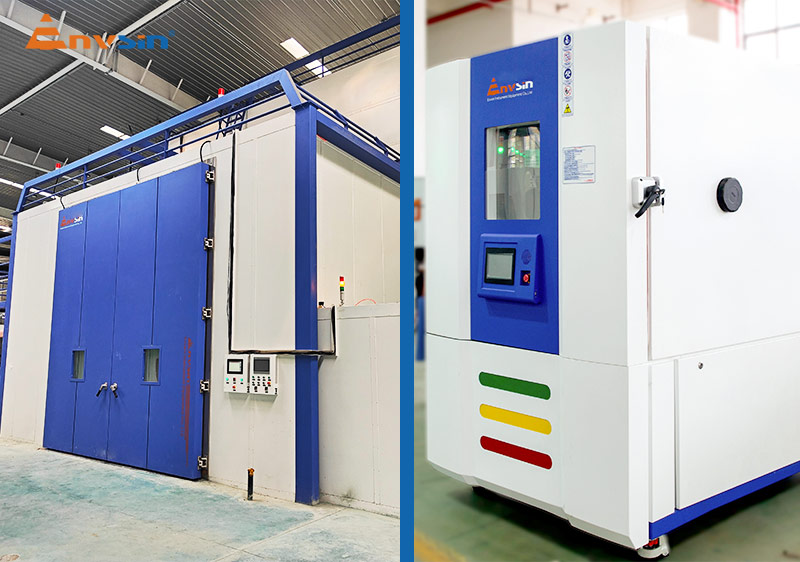
If your product will face sudden environmental changes — like a drone moving from freezing altitude to hot ground — thermal shock testing is non-negotiable. For daily use in varying climates, temperature cycling is more representative. Many engineers combine both: thermal shock for design robustness, temperature cycling for long-term reliability prediction. Envsin offers both thermal shock test chambers and temperature cycling chambers fully compliant with ASTM, IEC, and MIL standards, helping you run the right test without compromise.
Why Envsin Leads in Environmental Test Solutions
With over a decade of precision engineering, Envsin designs high-performance environmental test chambers trusted by Fortune 500 R&D labs. Our thermal shock chambers ensure fast temperature recovery and uniform stress distribution, while our temperature cycling chambers deliver energy-saving inverter technology and ultra-stable ramp rates. Every chamber is built for repeatability, easy integration, and global service support. Whether you need qualification for thermal shock vs temperature cycling, Envsin provides the equipment and expertise to accelerate your time-to-market.