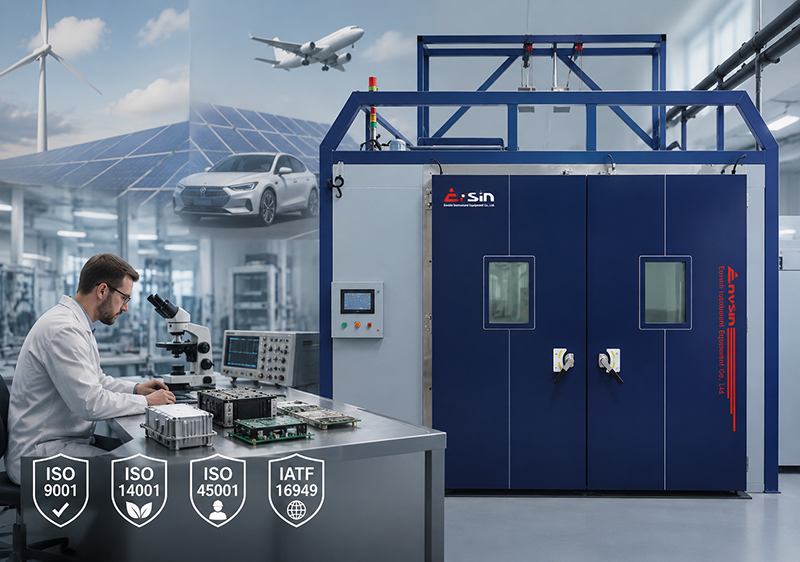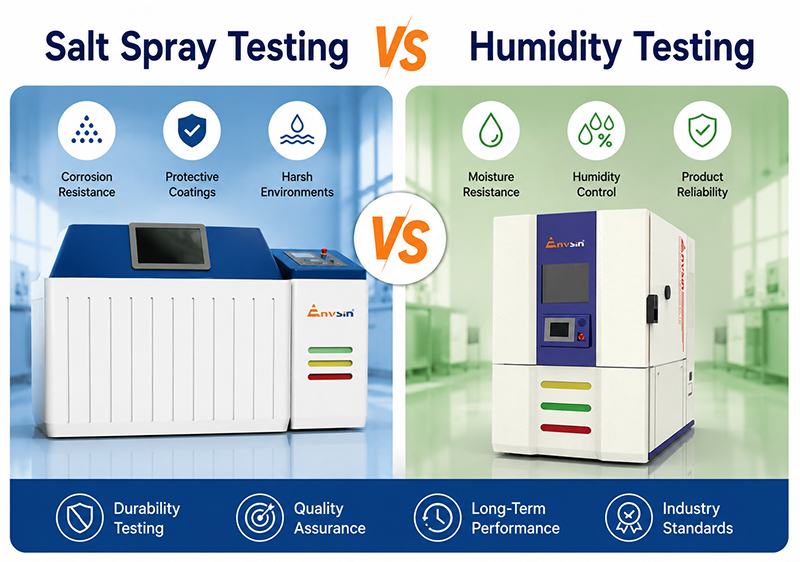






Imagine investing millions into a new electronic control unit, only to have it fail catastrophically during a routine desert heat test or arctic cold start. According to industry data, 42% of product failures stem from unverified environmental resistance. That’s exactly why environmental testing standards exist — they separate reliable hardware from expensive field recalls. For OEMs, automotive suppliers, and defense contractors, understanding these standards is not optional; it’s the foundation of market access and brand reputation. At Envsin, we engineer environmental test chambers that help you meet and exceed global compliance effortlessly.
Why Environmental Testing Standards Matter for Global Markets
From extreme temperature swings to corrosive humidity, real-world conditions are unforgiving. Standards like IEC 60068, MIL-STD-810H, ISO 16750, and ASTM D4332 provide a unified language for simulating years of wear in weeks. They ensure that a smartphone sold in Stockholm can survive a Mumbai monsoon, or that an automotive sensor endures thermal shock from -40°C to +85°C. Without rigorous environmental testing standards, product certification becomes guesswork. Companies that adopt structured protocols reduce warranty claims by up to 35% while accelerating time-to-market. Envsin’s chambers are built to execute these test profiles with precision, giving you data you can trust.
Most Critical Environmental Testing Standards You Should Know
Different industries rely on distinct frameworks. Below are the core standards that dominate qualification plans worldwide:
- IEC 60068 – The international baseline for electronic and electrical products. It covers dry heat, damp heat, cold, vibration, and combined climatic tests.
- MIL-STD-810 – Originally designed for US defense equipment, now widely adopted by aerospace, automotive, and industrial sectors. Its environmental life cycle simulation is extremely rigorous.
- ISO 16750 – Focused on road vehicles: electrical and electronic equipment, including temperature/humidity cycling, salt spray, and mechanical shocks.
- ASTM D4332 / D4169 – Standard practices for conditioning containers and packages, essential for shipping validation.
- JESD22 & IPC-9701 – For semiconductor and PCB reliability, often requiring highly accelerated stress testing (HAST).
Each standard specifies ramp rates, dwell times, and measurement accuracy. To achieve reliable results, your equipment must deliver uniform temperature and humidity distribution — exactly what Envsin environmental test chambers provide, with documented performance traceable to national labs.
Core Parameters & How Envsin Chambers Deliver Compliance
Temperature & Humidity Cycling
One of the most common requests: temperature humidity testing following IEC 60068-2-38 (test Z/AD) or MIL-STD-810 Method 507.6. Humidity extremes promote corrosion, while thermal cycles uncover solder joint fatigue. Envsin chambers feature advanced PID controllers with programmable profiles, wide ranges from -70°C to +180°C, and humidity control from 10% to 98% RH, all meeting Class 2 measurement accuracy required by the standards.
Thermal Shock & Rapid Rate Testing
Thermal shock (two-zone or three-zone) according to IEC 60068-2-14 and MIL-STD-883 is critical for assessing material resilience. Envsin’s thermal shock chambers transfer specimens between hot and cold zones within seconds, ensuring strict adherence to transition time requirements. No compromise on gradient or recovery.
Vibration & Combined Environment
Many standards now integrate vibration with climatic stress (e.g., MIL-STD-810, method 527). Envsin offers combined chambers that seamlessly integrate with shaker systems, providing repeatable, synchronized testing. This reduces test duration and reveals failure modes that sequential testing might miss.
Beyond hardware, Envsin equips each chamber with intuitive software that simplifies compliance reporting. Preloaded test profiles for IEC, MIL, and ISO reduce setup errors and ensure every run generates audit-proof data. Whether you perform environmental testing standards validation for R&D or routine production sampling, our chambers streamline the journey from prototype to certification.
How to Select the Right Environmental Test Chamber
Choosing the correct equipment depends on your target standards and product size. Key considerations:
- Temperature range & change rate required by your standard (e.g., MIL-STD-810 often needs 5–10°C/min).
- Humidity capability — non-condensing vs. condensing humidity profiles.
- Volume and load — chamber must accommodate product with sufficient airflow.
- Data acquisition: multi-channel sensors and Ethernet connectivity for remote monitoring.
Envsin’s engineering team provides tailored sizing and technical support to match your specific standard matrix. We’ve helped automotive Tier-1s, electronics labs, and battery test facilities implement turnkey solutions that exceed compliance margins. By investing in a high-performance environmental test chamber, you reduce risk and accelerate product launches.
Future Trends: Digital Integration and Smart Standards
With Industry 4.0, environmental testing standards are evolving to incorporate real-time data analytics and AI-driven anomaly detection. The upcoming revision of ISO 16750 will likely emphasize continuous monitoring during dynamic testing. Envsin is already ahead: our chambers feature cloud-ready data logging and automatic test report generation, enabling seamless compliance with next-generation requirements. As regulations tighten across EV batteries, medical devices, and renewable energy, having a future-proof partner is essential.
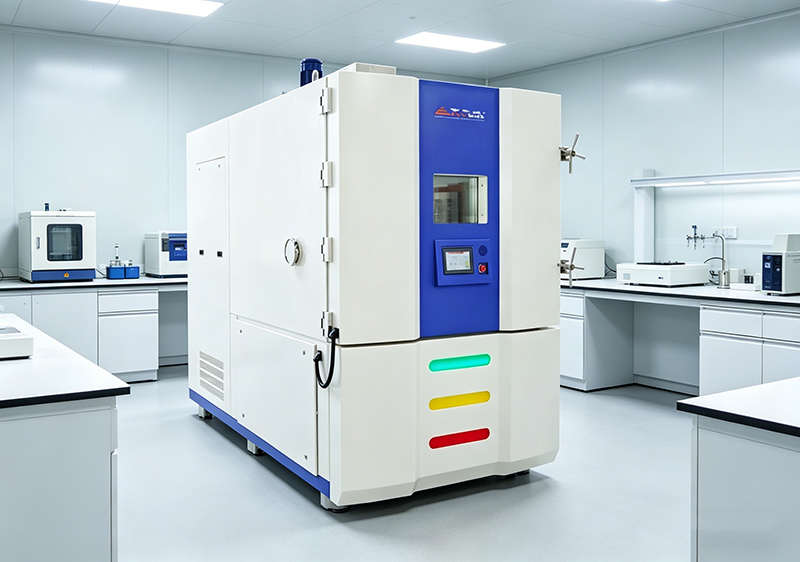
Adopting a proactive approach to environmental testing standards doesn’t just reduce liability — it builds customer trust. At Envsin, we design and manufacture every environmental test chamber to bridge the gap between engineering theory and real-world durability. From small benchtop units to large walk-in rooms, our systems are trusted by quality assurance teams across Europe, North America, and Asia.
Ready to master your environmental validation process? Talk to our application specialists to discover how Envsin chambers can help you pass any standard with confidence. Get your custom quote or request a demo — because reliable products start with reliable testing.